19.2 Profit & Loss
For most products, the goal of enhancements is either to increase the revenue your company brings in or to reduce the cost of creating or maintaining the product features. This is ultimately what product managers are responsible for; if the PM is successful, those numbers will be heading in the right direction.
In this checkpoint, you'll learn about the methods companies use to track profit and loss, how to predict future revenue or growth, and how to better estimate the impact of product changes.
By the end of this checkpoint, you should be able to do the following:
- Create basic financial models using profit and loss terminology

Understanding profit
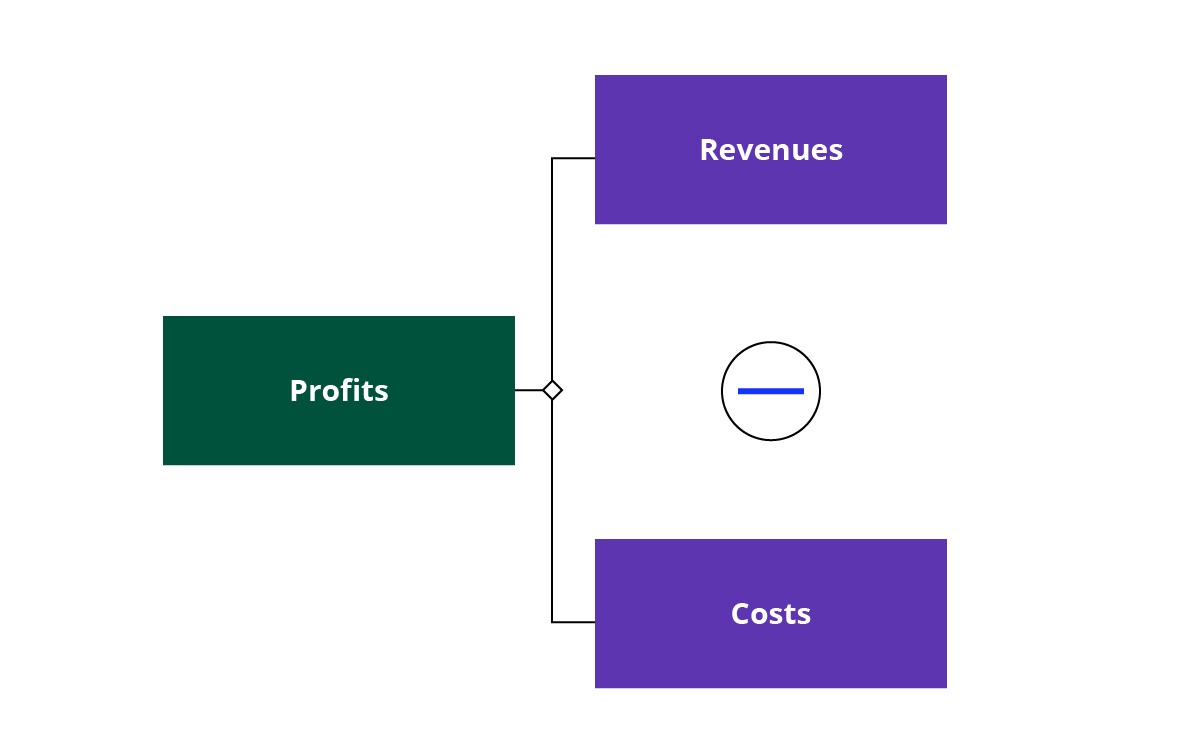
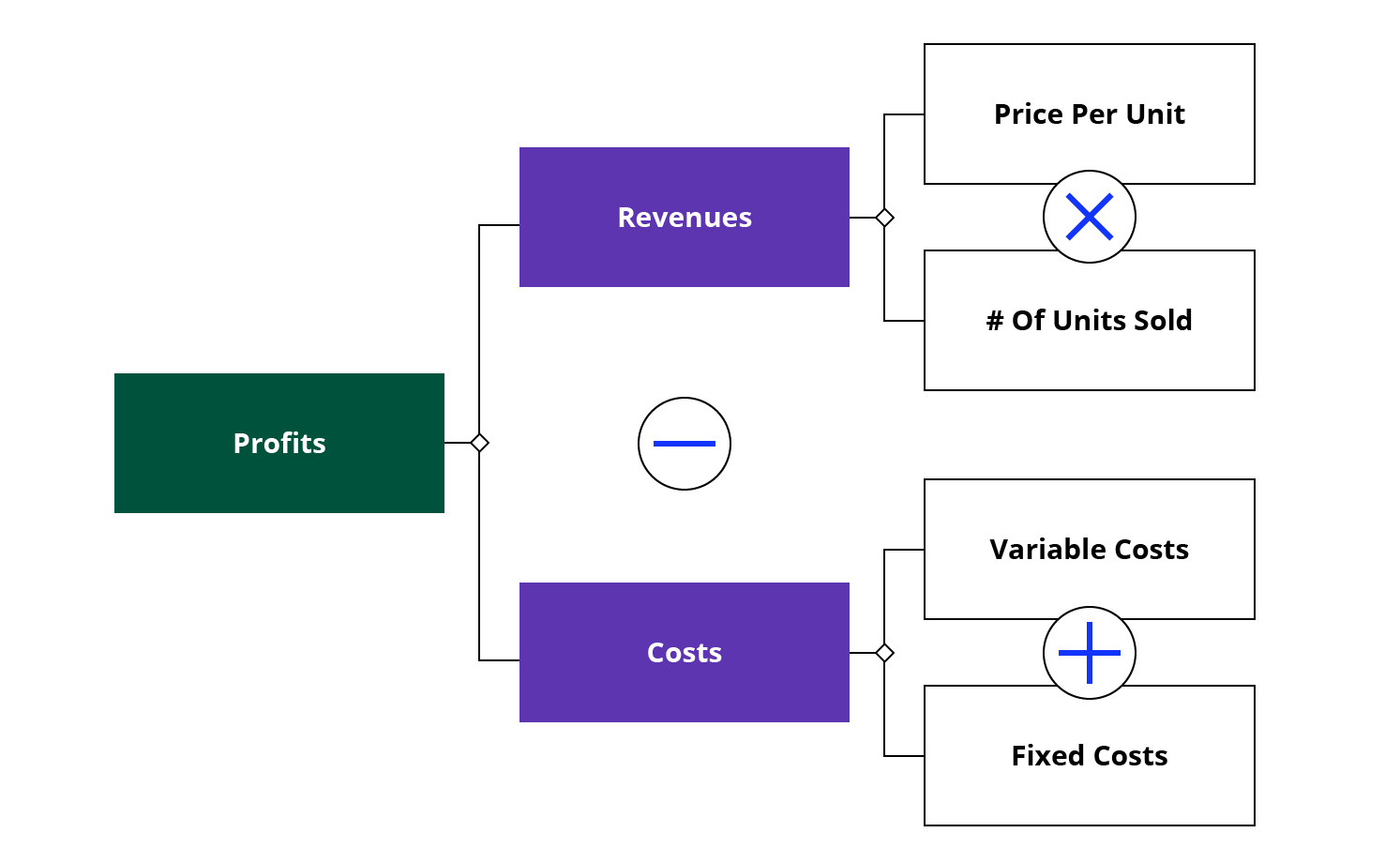
Profit is the goal of most business organizations. In short, profit is the difference between your revenue (the money you take in) and your costs (the money you spend). One way to think about this is by visualizing it as a tree diagram to show how these elements break apart:
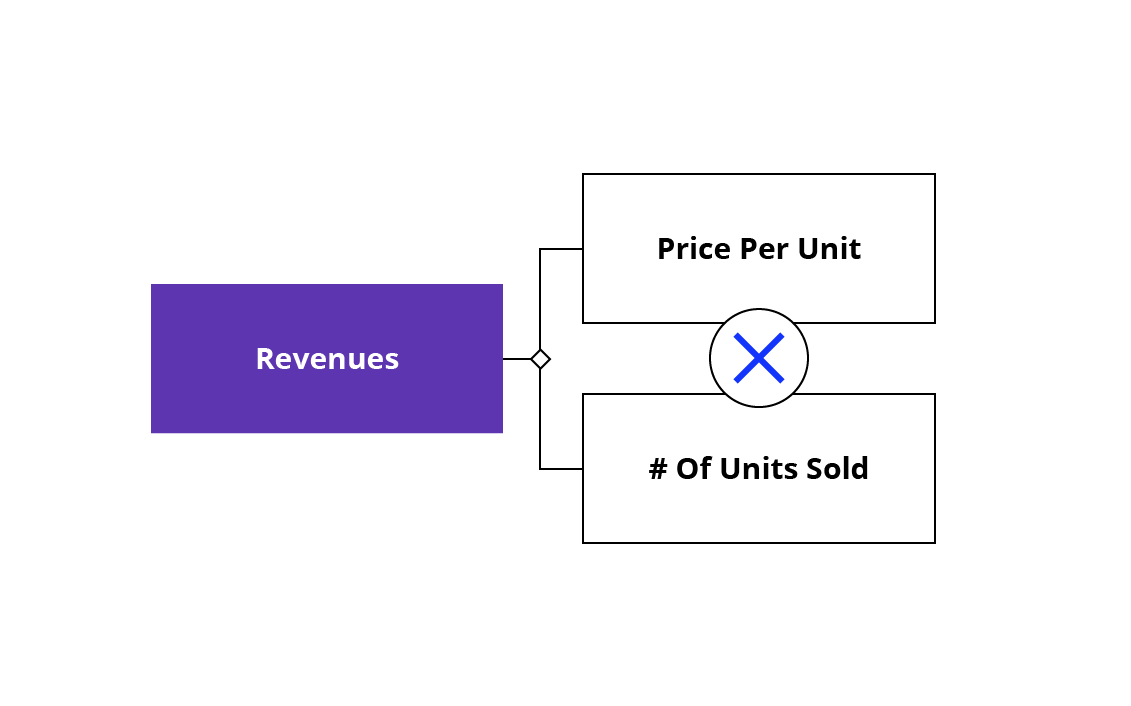
Whether you're selling monthly subscriptions to a software as a service (SaaS) product or selling one-time app purchases, revenue depends on two factors: the price at which you sell your product and the volume of your sales (number of units sold). It's simple multiplication—if one app sale generates a revenue of $0.99, then the revenue for two sales is 2 x $0.99 = $1.98. In formula form, your revenue is equal to the price at which you sell your product multiplied by the number of units sold.
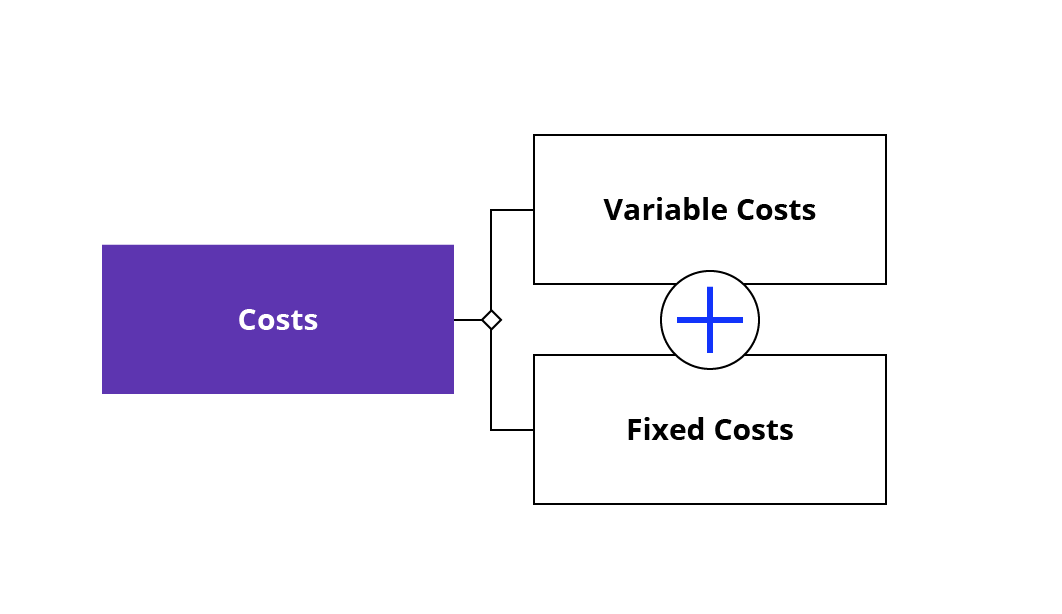
When breaking down costs, there are two main factors to consider: variable costs and fixed costs. Variable costs change based on the number of products. For example, maybe you need to buy one additional server for every 100 subscribers on your SaaS platform. Similarly, advertising expenses can expand and contract rapidly depending on your marketing needs. Fixed costs are independent of the number of products sold. For software products, these can include development labor and office space; your company can hire or fire employees independent of the number of subscribers you have. In this way, software products are different from manufactured products. Labor for software is more fixed, whereas for manufactured goods it is variable. You can see what the two types of costs look like in the diagram below:
It's important to know the unit cost of your product, or, in other words, the cost of adding the next user to your product. If your product is a search engine like Google, the cost of one additional user is almost zero—it takes very few additional resources to support that person. If, however, your product is a backup service where each user can upload multiple terabytes of data, your unit costs are very high, because a terabyte of storage can get really expensive.
To calculate the unit cost for software products, you can take the total cost and divide it by the number of users (which can be measured in subscriptions or downloads, for example). There are two ways to decrease your unit costs—lowering costs through improved efficiency or increasing the number of users while maintaining overall costs.
If you bring the profit tree together, the full picture will look like the diagram below:
Why should I care about the profit tree?
There are a few reasons why the information shown in a profit tree matters to a PM. For most tech companies, the labor costs of developers, designers, and PMs are the biggest fixed cost in the company. Since product managers drive what those developers and designers are working on, they have a huge responsibility to understand how labor costs affect profit and make sure those resources are used effectively.
Product teams can have a huge impact on profitability. Their work can improve revenue by creating new products that attract new customers and retain existing customers (especially in a subscription model) or by developing add-on products to generate more revenue from current customers. Similarly, product teams can reduce unit costs by improving the scalability of the product so that it can run on fewer servers, thus reducing variable costs. Product teams can also reduce fixed costs by building more efficient internal tools so that fewer employees are needed to support the product.
As a PM, you'll need to understand how your work fits into the company's profits. Is your product's goal for internal users to improve company efficiency? Is your product less about revenue generation and more of a tool to grow the organization's customer base and create a funnel for other products? Does your work improve the retention of subscribers? Your key performance indicators should align with a profitability goal, and you should trace the impact of your work.
Pricing
Setting the price of a product is one of the hardest business tasks out there. If a price is too low, you won't be able to make a profit. If it's too high, customers could be turned off by the cost. There are a few different methods for establishing a product's price, and as a PM you should be familiar with these. You won't necessarily be directly involved in pricing your product. But pricing is an important aspect of the business, and you need to be fluent in these terms.
Cost-plus pricing
The idea behind cost-plus pricing is to take your unit costs and add an additional fee on top of that, which is your profit. You can decide how much profit you want—5%, 25%, 100%, whatever will help your company reach its targets and is still desirable by your audience. Cost-plus pricing's main advantage is that you know exactly what your profit will be for each paying customer. On the downside, you could be underpricing or overpricing your product to make a profit on each sale.
In addition, the percentage of profit you intended to get per unit is highly dependent on maintaining the expected volume of sales. A cost-plus model works well for manufactured goods where much of the cost is variable. If a company sells fewer units, the company will have lower costs along with their lower revenue. But since software development has significant fixed costs, cost-plus pricing can be especially tricky for pinpointing an appropriate product price.
Value pricing
With value pricing, the price of a product is determined by the value it creates for the buyer. For example, if you have a SaaS startup that can automate the work of one human resources (HR) person, you should price the product at or below the salary of the individual that your software replaces. If you price it above the cost of an HR person, the customer would be better off hiring someone to do the work. Similarly, if a product makes a sales team twice as efficient, it should be valued around the labor cost of the people it enhances or the client's expected increase in sales.
Competitive pricing
Another way to price a product is to make it competitive with the price that competitors charge. You'll want to use this pricing model if you have direct competition for your product; it is especially useful if you're trying to use the price as leverage to increase your growth. For example, if you have a password management app that syncs across devices, you will look at the pricing of similar apps like 1Password or LastPass, and use those as a basis to set your product's price. The risk with competitive pricing is that setting your price according to your competitors could mean low or no profits; you're pricing it to be competitive, not profitable.
Unique pricing
When building customized software or products for specific customers, you may want to price it just for that customer using unique pricing, independent of any other factors. Those customers usually understand that they're paying for a solution that's tailored to their needs. Since your company can't distribute the costs across numerous users, these clients should expect to pay more than if they bought a solution off the shelf. In other words, you can charge a lot for this kind of product. You might also consider this pricing scheme if you have little competition due to having a unique solution with new or patented technology. This model can also establish a relationship where the client will need to rely on your organization to make any updates or modifications. This can be lucrative but unexciting work.
Pricing factors
The pricing models reviewed above can help you establish a general approach to pricing, but there are many factors that may affect your product's price. Here is a list of factors to consider.
Cost of related apps
This ties back to competitive pricing. When you are determining your price, you are not operating in a vacuum. You need to consider factors like the price of competing apps, the average price of other apps on the same platform, or the price of complementary apps. For example, if you're launching a mobile app in a marketplace where most apps sell for around $0.99 to $4.99, it's best if your price matches that standard. You should only price your app at a price point that is higher than most if there's a clear reason to do so, like if you're targeting a specialized audience or providing a subscription service with costs that exceed the typical app price. Similarly, if you're selling an add-on product for a SaaS platform like Salesforce, you need to recognize that Salesforce can cost thousands of dollars a month for an organization. Determine your price with consideration for the price your potential users are already paying.
Level of service
Service is another cost to think about when developing a product. If a product has 24-7 phone support, for example, that cost needs to be incorporated into the product price. Many B2B companies offer paid levels of support on top of the price of the product; in this case, more responsive service or additional support hours are not included in the base price.
Exclusivity and brand
If your product has a brand name or exclusive content, that can boost the price you can charge. For example, many users are willing to pay for a Netflix subscription to access exclusive content, and a company like Apple that enjoys a well-established brand name, a great reputation, and lots of loyal customers can sell products at a higher price point than others. For this reason, if you have a fitness app, it could be advantageous to partner with a sports apparel company like Nike or Adidas to sell the app under their brand name.
Demographics
Your pricing should consider audience demographics. If you're creating a B2C app for teens or seniors, you may want to price your product at a lower price or use a freemium pricing model (free with additional paid features) to appeal to the largest audience. By contrast, apps aimed at millennials or middle- to upper-class families can be priced higher because the intended target audience has larger disposable incomes and are more likely to willingly pay for apps.

Demand forecasting
One way to think about profits is to consider how a product's revenue and costs will change in the future. If you're expecting the product to grow significantly in the next year, that would drastically increase your revenue. However, it could also drastically increase your costs. It is therefore important to prioritize roadmap projects that will lower costs and ensure that profitability increases as the product generates more revenue.
Attempting to forecast demand for the product is important, as part of a PM's job is to optimize profit. You can approach forecasting by asking the following questions:
- How many users will I have one year from now?
- How will my product's variable costs change if we have twice as many users in the future?
- How would demand for my product change if the price increased 20%? What if it decreased 20%?
How do you answer these questions? You use estimation techniques that you learned about earlier in this program. Consider the first question with the following scenario: you recently launched a competitor to Salesforce that has 25 subscribers with 10 users each. Your unit costs are $2.00 per user per month. You want to predict how many users you'll have a year from now so that you can plan your costs and make decisions about your roadmap.
One way to estimate how many users you will have is by looking at Salesforce's growth and estimating how your growth might mimic theirs. After doing some research, you find that Salesforce had 150,000 subscribers in 2017 with 25 users per customer, and their growth has varied from 25% to 100% year over year.
Based on that information, you can list out the most likely possibilities:
| Customer growth | Users per customer growth | User unit cost change |
|---|---|---|
| No change | No change | No change |
| 25% increase | 25% growth | 10% decrease |
| 50% increase | 50% growth | 25% decrease |
| 100% increase | 100% growth | 50% decrease |
You then take the most likely combinations of these possibilities to calculate your future unit costs. Maybe some of them aren't likely or possible, so you only need to seriously consider a few:
| Customer growth | Users per customer growth | User unit cost change | Change in total costs |
|---|---|---|---|
| 25% | No change | No change | +25% |
| 25% | 25% | No change | +50% |
| 25% | 25% | 10% decrease | +40% |
| 50% | No change | No change | +50% |
| 50% | No change | 10% decrease | +40% |
| 100% | No change | No change | +100% |
By testing a variety of revenue and cost factors, you can forecast that customer growth will probably be 40% to 50% with a best case of 100% growth and a worst case of 25%. You can now take those estimates and do the rest of the work for prioritizing next year's roadmap.
In general, you should do the following steps for forecasting:
- Review all the possible items that could impact your forecast.
- Quantify each possibility based on past data, competitor data, and other research.
- Use the best, worst, and expected case as your results.
Nearly every industry has reports that show you how the market is changing year over year. You can also find proxies for your growth, like a competitor's growth, the growth of your own similar products in the past, or expected demographic changes among your target audience.
These techniques are good for more than long-term planning. They're useful to predict the impact of an individual feature launch, the launch of several items on your roadmap, or even for forecasting years into the future.
Practice ✍️
Build a model of demand and revenue for an ice cream shop in a small town that attracts a lot of tourists. Answer the following questions about your model:
- What are all the factors that go into the demand for your product?
- What are the fixed costs?
- What are the variable costs?
- How would you price your products, and what revenue can you expect as a result?