19.4 Increasing Growth 🎯
This section includes an Activity 🎯
Now that you have a basic idea of how to track product growth, it's time to start thinking in more detail about the actions product managers can take to increase product growth. If your experience is primarily in business strategy or sales, you might even find yourself with the title of growth product manager. This is a role that focuses on the parts of the product experience that are the most critical to gaining new users and getting them to stick with your product.
In this checkpoint, you will learn about methods of increasing product growth. You'll also review frameworks that help create products and features to improve your product's growth.
By the end of this checkpoint, you should be able to do the following:
- Apply product growth frameworks to different types of digital products

The rise of the Growth PM
There are many kinds of product managers, but one type—the growth product manager—has been in especially high demand in recent years. Growth PMs have a set of specialized skills and the ability to drive business results. Growth is an essential part of every product, whether you're trying to attract new users or retain existing ones. Even if you won't be a growth PM by title, part of your job will always be to think about ways you can expand your product's audience and revenue.
You might have heard of the term growth hacking. This term gets used often because companies are always interested in easy ways to rapidly increase their users or revenues. But the truth is that there are no cheap or easy ways to grow a product. There are, however, specific methods you can use to change or improve a product in ways that encourage growth.
How growth is different
Growth PMs usually focus on the acquisition of users and on monetizing them—that is, finding ways to get more users to pay more for the product. One way to think about it is that most PMs work for the customers, while growth PMs work for the business.
A growth PM depends on experimentation to find the adjustments that impact the company's metrics. That means the team needs to work quickly to test many ideas, iterate on the ones that work, and discard the ones that don't. Growth PMs tend to be strong prioritizers that focus on the minimum viable product (MVP); they aim to try the best ideas first and focus on the ideas that require the least amount of effort.
While all PMs need to be collaborative, growth PMs need to work especially closely with the sales, marketing, and other product teams. Growth PMs often work across products, identifying opportunities to coordinate between products and generate growth. Individual product teams that don't have expertise in growth might consult a growth product manager to help the team identify and seize growth opportunities.
How can you track growth?
You can think about growth in two ways—user growth and revenue growth.
User growth is the net number of new users over a period of time. For example, imagine you start a month with 1,000 users. By the end of the month, 200 new users have activated, but 100 users churn out. That month's net user growth is 100 people. Subscription products often track their user growth in terms of the number of subscribed users. This means you can grow a user base either by finding new users or by reducing the number of users you're losing.
Revenue growth is the net new revenue over a period of time. If your revenue last month was $10,000 and this month it's $12,000, then your revenue grew 20% month-over-month. If you have a subscription product, you could track your growth in terms of Monthly Run Rate—the total amount of subscription dollars you receive in a month—or Annual Run Rate—the amount of subscription dollars you receive over a year. When measuring revenue growth, you can increase revenue by adding new users, reducing user churn, or finding ways to get existing users to pay more.
Besides users and revenue, your other product KPIs are also a measure of growth. For example, conversion rates, users of specific parts of the product, or other metrics discussed earlier in the course might all be related to growth. Many of these metrics are tracked specifically to inform the product team. User and revenue growth numbers, however, are typically tracked company-wide; product teams collaborate with other teams to increase those numbers.
Growth comes after product-market fit
One important lesson about growth is that you can't expect growth if your product isn't working for your users. Think back to when you learned about product-market fit—the match between what your product does and what the audience you're targeting wants and needs. It's essential to confirm product-market fit before working on growth. If you try to grow your product before confirming fit, you risk users not adopting your product or churning out quickly.
How do you know if you have achieved product-market fit? You check product KPIs, user sentiment, and net promoter scores (NPS), among other indicators. If those metrics are performing well, then it makes sense to turn up the volume on growth efforts. After you've confirmed product-market fit, the methods described below could help improve your product's growth rates.
The hooked loop
As mentioned, one way to increase growth is to decrease user churn. A specific method to do this is by building a hooked loop, a series of steps that build user habits as users engage with a product. The hooked loop was introduced in the book Hooked by Nir Eyal. Eyal is a writer, consultant, investor, and teacher focused on the intersection between psychology, technology, and business. In Hooked he attempts to answer the question: how can you build products that can shape, and even manipulate, users to take actions?
If you can succeed in making your product habit-forming for your users, it accelerates your product's growth. It keeps users retained; stopping them from churning out. And it's far cheaper to retain an existing user than to acquire a new one.
The hooked loop includes four steps that you can follow to create a habit-forming product:
- Trigger users to use your product, either with an external or internal prompt.
- Have users take an action in anticipation of getting a reward.
- Make the rewards variable, so that users are surprised by the feedback they receive.
- Make your users invest time and effort into your product to increase their devotion.
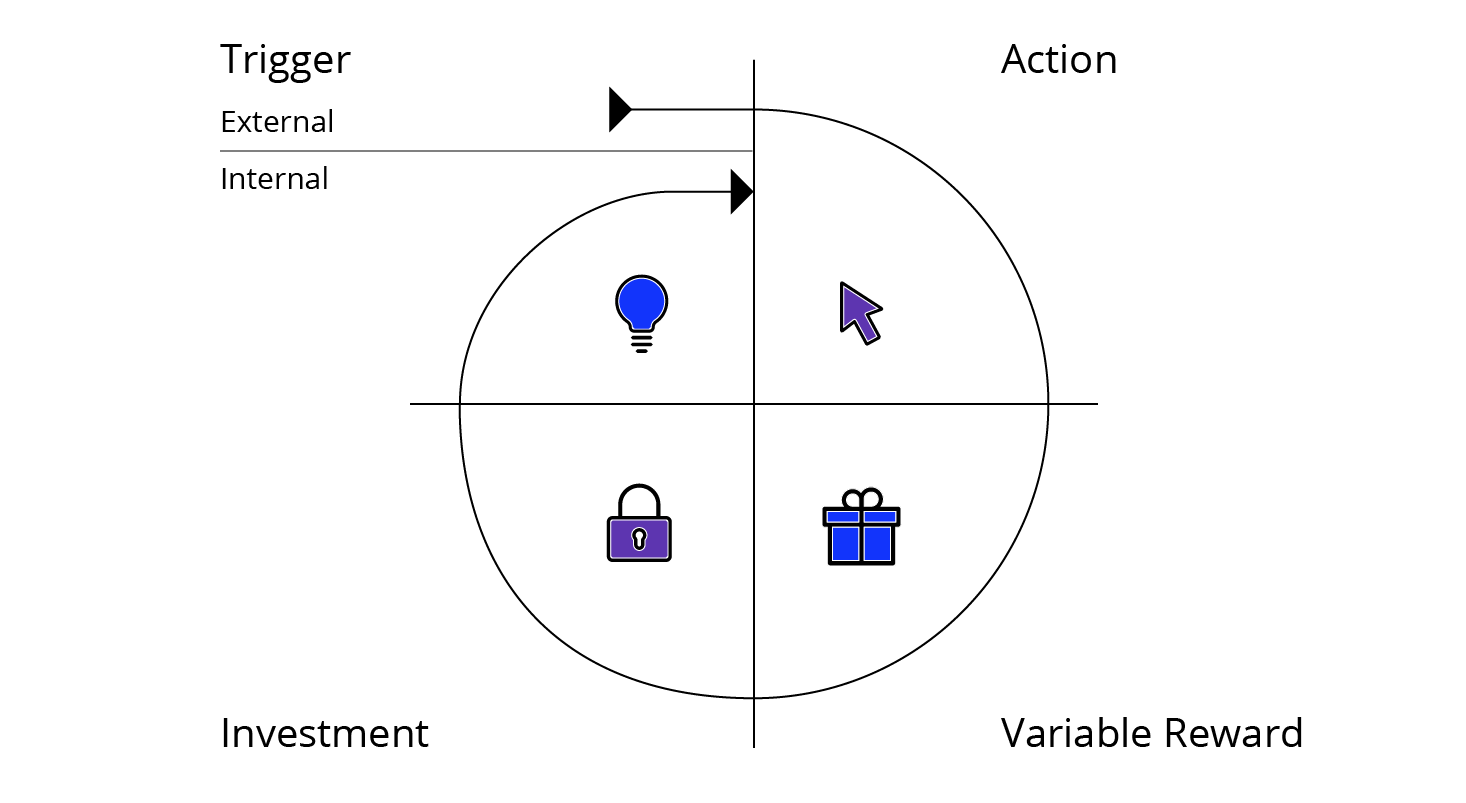
Next, you can examine each of the steps in more detail.
Trigger
A trigger is the means by which someone starts their behavior or habitual activity. These can be external triggers—like a notification on your mobile phone, a reminder from your calendar, or the sound that tells you you received an email. Many user interactions with an app are driven by external triggers.
At some point, the external triggers get internalized by people. This means that the trigger or prompting thought will occur without the external stimulus. These internal triggers mean that a habit has formed. When you're in the habit of checking Facebook several times a day, for example, notifications are no longer needed; the trigger has been internalized.
Action
An action is the step you want the user to take in response to the trigger—opening Facebook to see new posts, pulling down on your Instagram feed in the hopes of loading new photos, or opening Spotify to see which podcasts have downloaded.
Whether or not your users take that action depends on two things: their motivation and the ease of completing the action. A highly motivated user will jump through hoops to achieve that reward. Equally important is the fact that if that action is easy to do, the user is more likely to give it a try.
Variable reward
The action should provide a reward, but that reward should be variable to maximize the chance that your users will get hooked on your product. When a user reloads their news feed, it might have new items or might not. And if it does have new items, the user doesn't know how many they'll see or which ones will be important to them.
The unpredictability of a reward, or the variable reward, is the part that hooks us as users the most. It triggers a rush of dopamine—the "feel good" brain chemical response to rewards (the same thing happens when you win the jackpot on a slot machine). People will seek out those highs again and again. In the same way, they'll come back to your product to see what reward they will get next time.
Investment
Finally, you want users to feel invested in your product. Their investment can take many forms, such as effort, data, or money. Users perceive the product's value as higher if they have to put in work or input in order to get that value. Investment also creates value in the product for other users. One user's investment (such as posting on Facebook) often becomes part of the variable reward for other people (new stories in the feed).
So when you check your Twitter feed, the tweet box is easy to find. You can easily create your own tweet and invest in the product. Your tweet makes Twitter more valuable for others. Also, you'll come back to see how others react to your tweet. This further reinforces the loop; when someone retweets or likes your post, you receive another variable reward.
The consequences of putting this together
Successfully building a hooked loop will result in a habit-forming product for users. This can be both good and bad. It's good that users find value in your product and want to use it often. It's bad that you're building an addictive product, as the habits your users are forming could be harmful to them. You'll learn about the ethics of building products in a future lesson. For now, focus on the growth value of building a habit-forming product, and think carefully about what you're building, how your users will use it, and how it will affect them.
Viral loops
Another approach you can use to increase user acquisition is to create a viral loop. You might have heard about viral videos and how they can impact business, like how Dollar Shave Club started with an incredibly popular video shared by millions of people on social media.
Products use viral loops to encourage users to share their product with others. Those users then share the product with other people, and the product spreads. One example is Dropbox. Rather than spend millions of dollars on advertising, the company grew its initial user base through a referral program with incentives. If a user referred a new user to Dropbox, both users received even more storage space on Dropbox for free. Dropbox created easy ways for people to share their referral links via social media and email. The incentive it offered is double; it encourages current users to share and gives recipients a reason to try the product.
Harry's, a company that sells grooming and shaving supplies, did something similar when it launched. If you referred 50 people, Harry's would give you a free year of shaving supplies. In both cases, the incentive pushed people to share the product. New users who were acquired through this method were also offered the same incentive, so they too kept sharing. This creates virality on your product's behalf with moderate effort and at a much lower cost than advertising.
Referral programs like those used by Dropbox and Harry's are very popular these days; companies from Airbnb to Lyft and Uber offer incentives to existing users who invite their friends to join.
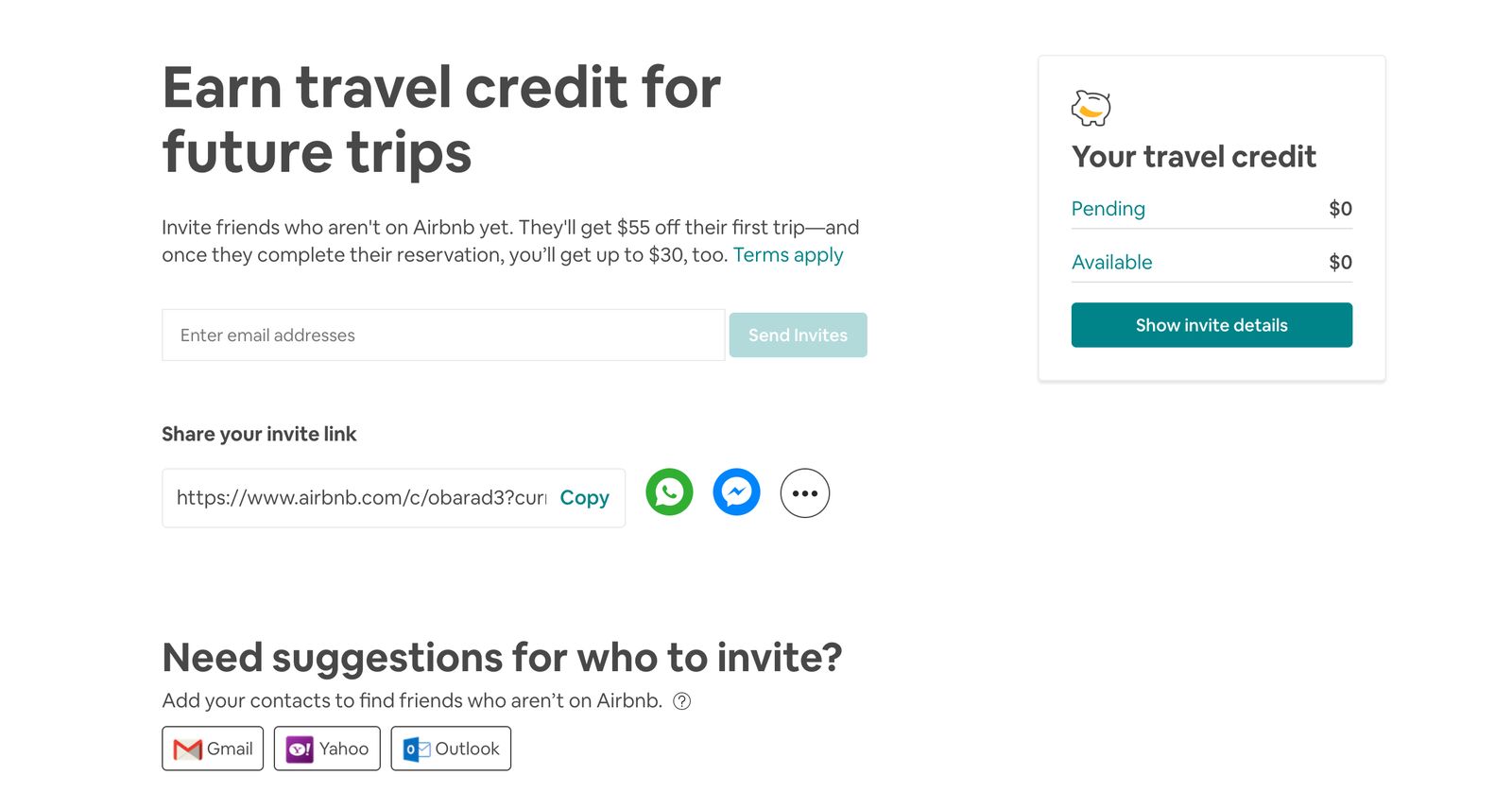
The viral loop approach is most effective if the incentives are a good fit for your product and users. For example, the bonus of getting 50 MB of free storage from Dropbox for a referral was huge at the time. And it cost Dropbox almost nothing to give that space away compared to the value of another potential customer. When trying to create your own viral loop, look for opportunities where your incremental costs are low and the return on investment is high.
Word of mouth
Word of mouth is one of the most important and effective ways you can grow your product. How do you get this kind of exposure? By making a great product that people rave about or by showing up to places where your users are.
For example, Slack has grown enormously since its launch in 2013, most of it without spending any money on advertising. It grew through word of mouth. One team would adopt Slack, then people on that team would recommend it to other teams. A person who left a company that used Slack would bring Slack with them to their next place of employment because it was just that good. Similarly, Tinder's first launch was at a college party. Tinder decided to sponsor the party and make the price of admission installing Tinder on your phone. This kind of growth can only be done person to person.
When considering a word of mouth strategy, your product needs champions who others trust and will follow. If your product is good enough, other people will be more effective at helping its user base grow than you can ever be. Can you think of a product that you use regularly which you heard about from a friend or someone you trust?

Further down the growth funnel
Growth PMs aren't only concerned about getting people into the top of the funnel. They also look for opportunities throughout a product's experience to grow the user base and achieve crucial goals. See below for some examples of how you can impact growth at all stages of product development:
- User onboarding: Creating a great first-time user experience helps users see the value of a product as quickly as possible. It also ensures that users have the information to be successful.
- Personalization: Using machine learning and AI technology can help make a user feel like the product was made just for them.
- Reacquiring users: Finding users who tried but gave up on the product and attempting to entice them into using the product again.
There are many more opportunities to expand the growth funnel based on your specific product. Growth isn't only about getting users to your app in the first place. Growth goals can be accomplished by targeting many points in your funnel simultaneously. As discussed in the modules dedicated to user funnels, sometimes the best place to focus your attention is not the top of your funnel, but rather a few steps into the user's experience with your product.
Measuring growth by segments and cohorts
It's not enough to try to grow your product. You need to measure and adapt your growth tactics based on how your users react to your experiments. This lets you make informed decisions as you move forward. As with MVPs, you can choose to iterate on your growth ideas, ship them, or scrap them. The simplest way to decide is to analyze your results.
Remember to always check your data by breaking it down into cohorts and segments. Segments are when you group your users by demographics or psychographics like age, profession, or personality. Cohorts are staggered segments like users who joined this week versus last week or users that completed a specific activity (or didn't). If you run a growth experiment and see results with a 2% increase, don't just call it a failed test. Dig deeper—maybe it worked really well for a specific group of users, like users that completed certain tasks, or a group that all used one person's referral code. These details are crucial for making the best decisions in your growth efforts.
Activity 🎯
In your notebook or a shared document, respond to the following prompts:
- For each of the products listed below, how would you describe the company's strategy for product growth? Do some research about the company's site and how they are portrayed in the industry media to learn more:
- Grubhub
- Lyft
- Pick your favorite app. Come up with a way to improve it using either the hooked loop model or a viral loop. If you were the PM for this app, how would you encourage users to stick with the product? List the steps you would take.