4.5 Uncovering Personas and Segments ⭐
This section includes an Assignment ⭐
Once you've interviewed users and tested your hypotheses, it's time to share what you learned with others in your organization. Communicating information is one of your most important responsibilities as a PM. It's also particularly important to ensure that everyone is in agreement about who the product's users are.
How will you achieve that goal? By creating user personas. Personas are fictional yet realistic representations of your product's key audience or ideal customers. This simple tool can help align teams around their users and bring clarity to problems and goals.
By the end of this checkpoint, you should be able to do the following:
- Create effective user personas
- Describe how to use personas in product management
The need for personas
Imagine that you design bags. You know it's just not possible to custom design bags for every potential customer. You also know that different people keep different things in their bags. What kind of bag would each type of customer need? Here are just a few of the many kinds of people who might use a bag:
- An artist who carries pads of paper, a pastel set, and a pencil set
- A software developer who carries a laptop, charger, and battery pack
- A parent who carries diapers, baby wipes, extra clothes, bottles, and food
It's important to know that seemingly minor decisions can impact whether or not customers like your bags, such as the number and size of pockets. But who are the most important customers to satisfy? Who are the least important customers? Which customers have similar enough needs to group together?
The same questions apply to digital products. Consider Twitter users. Can you think of who some of the main groups of Twitter users are?
- Companies who use Twitter to share their news
- Advertisers who promote their content on Twitter
- Prolific users who share lots of content on Twitter
- Lurkers who only follow people but don't post content
Those groupings can hide important information. For example, advertisers come in all sizes and have different needs. Twitter's largest advertisers may need tools to manage million-dollar advertising budgets, but smaller advertisers may only run a few ads. Similarly, prolific Twitter users could include celebrities with millions of followers, companies who use Twitter for customer support, and your social-media obsessed friend who has only 200 followers.
This is where personas come into play. By distilling down the needs of your users, you can better understand their needs and make sure to group them properly.
What are personas?
A persona is an archetype that represents a group of users or important customers. Imagine you're the PM for an email-signature app that has 100 users. Now imagine that 30 of them are small business owners who use your product for identical reasons, while each of the remaining 70 use it for their own unique reasons (none of them are similar). If you make improvements with the needs of the "small business owners" group in mind, your product improvement will benefit all 30 users. But how will you know what these users need?
You could further research those 30 users—interviewing several of them to understand their needs, reviewing their use patterns, and looking at the factors that affect their satisfaction with the product. After distilling all this information, you can mash them together into a fake user profile you will dub "small business owner." This is the user persona representing that group of users.
Using personas
The main reason personas are used is to ensure consistency when thinking about your users. Imagine talking with your coworkers about your product's 100 users. While you're thinking about the persona you created of the 30 users you've researched, your boss may be thinking about one specific user with whom he spoke yesterday, and your UX designer may be thinking about one of those other 70 users whom he interviewed last week. If you're all speaking about different, unique users, you're likely going to disagree about how to build your product. And yet you are all arguing from the point of view of actual users. Personas help avoid such disagreements.
Personas also help prioritize your work. Sometimes you'll need to focus on a subset of users to achieve your company's goals. By focusing on specific problems, you can prioritize features for one group at a time, rather than spreading yourself thin trying to solve too many problems at once.
Personas are useful to different teams in different ways. Product and UX teams like to use personas to help focus on user problems and explain how one group's problems are different from others. Sales and marketing teams like personas to help them target the right customers. Even executive teams can use personas to help with company strategy and direction.
Finally, personas need to be kept up-to-date. You might find that your user base has changed over time, like when Facebook expanded from college students to the global population. The process of refreshing your personas helps accomplish the first two goals mentioned above—keeping your team on the same page and helping you better prioritize your work. When your users change, your personas change, and then your product changes.
Who are your personas
When creating your personas, keep in mind the following types of people.
Main users
Most, or all, of your personas will be the actual users of your product. You can group your users into personas in many ways—by their demographics, the devices they use, how frequently they use your product, etc. Some of those groupings are useful for creating personas, but many of them can be misleading.
For business-to-business (B2B) products, you'll usually group them by their organizational role or by how they use your product. For instance, an administrator may need to create and remove accounts, while a manager might need to easily review a user's activity. In a similar way, consumer product personas are often grouped by their use patterns and habits. For example, what needs would a highly active Instagram user have compared to a user who only shares their activity with a small group of friends? When creating personas, look for similarities in your users' activities and responsibilities.
Buyers
Many products are purchased by their users, but some are purchased by someone who is not the main user. Parents buy many products for their children, but the values they look for may be very different from those of the kids who eventually use the product. Similarly, a business purchaser is often an executive, while the actual users are members of that executive's team. If your user and your buyer are different people, you will need to think about the personas of both.
People affected by your product
Sometimes you need personas for people who are not your users but are nevertheless impacted by your product. For instance, you may run a product that helps marketers target their ads and advertising at specific buyers. While your users may be specific people on the technology and marketing team, your product's output may be used by a different group of people who the marketing team reports to. That different group of people could be important enough to create a persona for.
What goes in a persona?
A persona is a composite of many people. You can create a persona with as much or as little depth as you prefer, but it helps to give the fictional user enough traits to make them feel more real. That said, creating personas is not a creative writing exercise. Don't embellish unnecessarily—treat personas as a tool for clarifying who your users are.
Remember this video we shared in one of the earlier checkpoints. Time to view it if you haven't already. The video below provides a good summary of what should go into a user persona.
The following sections will outline in more detail what should go into the persona you will share with your team.
Name, photo, demographics
Give your persona an identity—a fake name and a stock photo. When you're discussing them with your coworkers, refer to them by name rather than by role or other identifiers. While it may feel silly to talk about non-existent people, this will help bring your personas to life in the eyes of your coworkers. This is especially important for team members who don't get to interact directly with real customers.
Add a few relevant demographic details, such as age, gender, where they live, professional status, and salary range. Include only information that is relevant to decision-making, but think of decisions broadly. For example, age is often not relevant to product decisions, but it could matter a lot if your product is used primarily by the elderly. And, even if it doesn't impact the product, it could be relevant to your marketing team when deciding how to advertise it.
Psychographics
While demographics are factual information bits about a person that may be included in a government form, psychographics represent their interests, hobbies, lifestyle choices, and other "soft" characteristics. Again, some of these will be relevant to your product, but others will not. Think carefully about which psychographics help your organization better understand your users and their problems, and avoid unhelpful fluff.
Problems and pain points
Product management is about problem-solving, so always be concrete about what problems a persona has. For example, it is not enough to say that a persona of a PMcademy student has a problem with her current job. You would want to be more specific. Does she feel unfulfilled in her current role? Is she not making enough money? Does she want more creativity and stimulation in her work? Such problems or pain points are often the triggers that spur people to take action. Be sure to include in your persona what is driving your users to seek a solution.
Goals and needs
Write out the goals that are unique to a persona. Don't include universal goals and needs common to all users, like income, housing, or validation from peers. These are not unique enough to differentiate your user persona. On the other hand, don't include goals that are so specific that they may not apply to other similar users you are attempting to group into a persona. For instance, say you are creating a persona for a user who works in sales. An example of a need that is too broad would be "the user wants to be good at their job." A better, more specific goal to include would be "the user wants to increase conversion rates."
A persona's goals will often align with problems—the PMcademy student from the earlier example may have a problem with their current career path and, as a result, has a goal of embarking on a new career in product management. Goals are ideal outcomes. A single problem can be solved by many goals, but only a few goals are important to this persona.
Scenarios or typical activities
It can help to list out "a day in the life" of a persona to help others view them as a fully fleshed-out person. Focus on important activities in the context of building a product. For example, "commutes to the office" is a typical daily activity, but it is not very important to include in a Salesforce user's persona. "Works remotely while on sales pitches" could matter if, for example, you're trying to decide if you should focus on mobile app development.
Skills
Skills are relevant when you have a product that may be difficult to learn or is used only by specific segments of people. For instance, if you run a product like Looker that makes it easy for teams to analyze information in databases, you will likely create different personas for people with strong database skills and for people with little to no database skills.
Making effective personas
It's time to get to work on a few personas. Here are tips for making them better than average.
Base them on real data
The best personas distill the behavior, demographics, and other information from actual data. A persona doesn't need to reflect the average of all the data, but it should be recognizably close to it. You'll learn more about data analysis later in this program. If you have a data analysis team, you will collaborate with them on this.
Talk to enough people
A persona isn't just data. A persona has goals, problems, and other human characteristics that you need to express. Conduct interviews with people, and then use their most commonly expressed goals and problems in your persona. It may be easy to imagine these for your users, but be careful not to invent them. Your product is only as good as its ability to help users solve their real problems and accomplish their real goals.
Create archetypes, not stereotypes
The difference between an archetype and stereotype is that an archetype is the typical version, while a stereotype is filled with assumptions. You don't need to assume anything for your personas. Assuming something about a specific group of users can actually be offensive or lead you in the wrong direction. Instead, base it on real info, as previously discussed.
Elicit empathy and understanding
Your persona is only as good as its ability to communicate the feel of a real person. Make sure that everything in the persona is easy to understand. As much as possible, focus on conveying the emotional qualities of their problems and goals—disappointments, aspirations, and hopes. If your personas are too clinical and not human enough, they'll likely come off as boring and risk being dismissed by your peers.
Make it real
A good persona looks like a real person who uses—or is influenced by—your product. If your persona doesn't look or feel like a real person, or if it resembles a real person but is not true to the characteristics of the people who actually use your product, then it's of no value to you or your organization.
Change over time
Like the people it represents, a persona is not static. Your product will change, your users will change, and their environments will change, so your personas should change, too. Review your personas every few months, but especially when you make any strategic shifts in your product.
Sample personas
When creating multiple personas for the same product (as you'll do in the assignment later), build your personas together. While building them in isolation is possible, building them as a group is more fun and will lead to more accurate personas as you balance out different characteristics among them all.
Below are some sample personas for various products. Review these as you think about how you can create your own. Each of these samples uses a different layout. When you create your personas, use a consistent layout. Doing so will present a better experience for your audience.
This persona was created for a shoe-shopping e-commerce site:
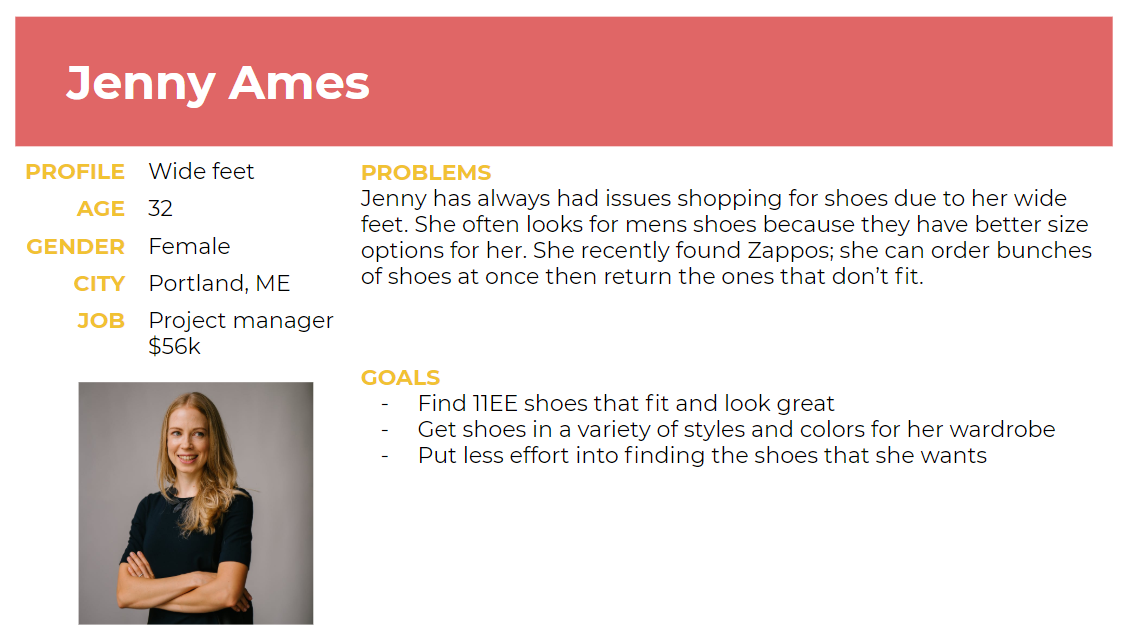
Note that the persona is focused on relevant information, like Jenny's shoe profile, her location, and her trouble finding shoes. It also includes her salary, which provides insight into the type of shopper she is. It's succinct and to the point.
Here is the next persona:
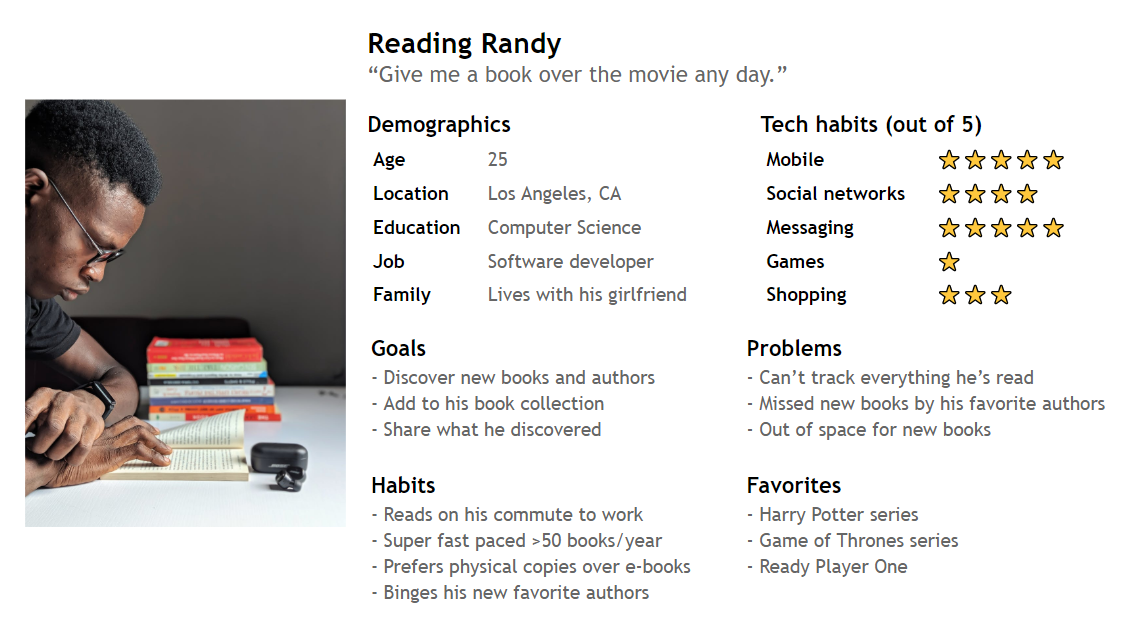
Randy's persona here relies more on lists to present information. As you can tell from the details included, this persona was created for a product related to books. The star ratings are a good way to summarize skills, interests, or other hard-to-explain characteristics.
Here's another persona example:
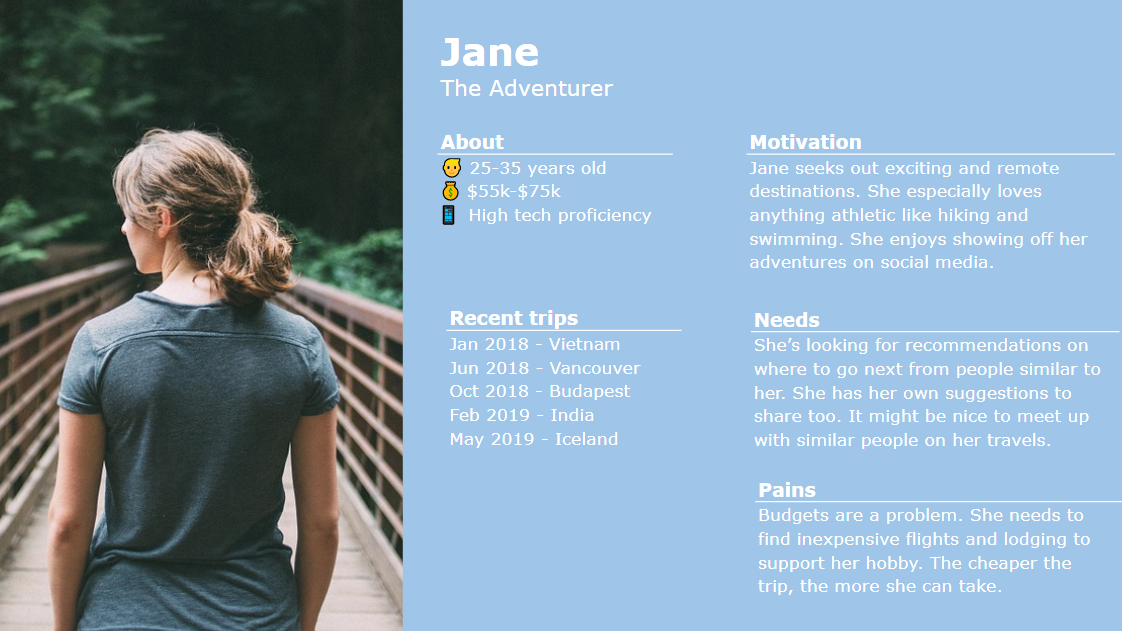
This one was developed for a travel-based social network. Note the "Recent trips" column—sometimes featuring specific traits is useful for rounding out a persona that is specific to your product's industry or area of focus.
There are many great persona templates online. Check out these examples for some ideas.
- Marketing analytics site Alexa has provided 10 great examples on their blog.
- Venngage, an infographic website, offers more than 20 templates, tips, and examples.
- You can find 15 templates at Justinmind, a site that offers prototyping software.
You're encouraged to build your own library of persona resources as you progress through this program. You may find these to be valuable later in your PM career.
Assignment 04 ⭐
Time to bring together everything you learned about in this module and go talk to some real users!
Return to the product you selected for the previous checkpoint's activity. (Note: If you wish to switch to a different product, you are free to do so, but you will need to recreate the interview guide.) Find at least three users (or potential users) of your chosen product who will be willing to talk to you. You will need to create more than one persona, so beware of choosing three users who are all exactly the same. And try to cover several user groups (such as different ages, different roles, and different use cases).
Interview each of these users, using the interview guide you created. Make sure to also collect relevant demographic and psychographic information to help you create fully fleshed-out personas.
Use what you've learned from your interviews to build at least two user personas. Present your personas in a one-slide format similar to the samples included in this checkpoint above.
Submit links to your persona slides in the slack channel. Ensure that the privacy setting allows anyone with the link to review your materials.
Submission
In our slack workspace in the channel #assignment-04 paste your answers