2.3 Daily routine as a PM 🎯
This section includes an Activity 🎯. Sections marked with a 🎯 are the one's that have an activity in them. Activities are optional assignments. But we highly recommend you do them.
When preparing for your new career, you are probably wondering: what does the day-to-day of a product manager look like?
This checkpoint will also attempt to describe these tasks and give you a general sense of what you can expect, including the main responsibilities of product managers, what other teams will be doing around you, and how those teams intersect with each other.
Finally, you'll learn about the career path of a product manager. Generally speaking, as you gain experience, your responsibilities will increase and you will have opportunities to manage other product managers. The goal of this program is to help you get your first product job and prepare to climb that career ladder.
By the end of this checkpoint, you should be able to do the following:
- Describe a typical day for a product manager
- Describe the responsibilities of other teams and how they cross over with PM work
- Explain the PM career ladder and how responsibilities differ based on your title
Your responsibilities as a PM
Product managers do a lot, but there are a few things that are especially important for them to focus on. Regardless of your exact title, the main things you'll do as a PM include the following:
Communicating priorities. Much of the product manager's job is to make decisions about what's next and explain why it's the right decision. You’ll do this on all levels: with the executive team to defend your choices about the priorities for the next few months of work, with your designers so they understand what needs the most attention, and with your developers so they stay motivated and work on building the right things.
Unblocking teams. PMs can expect problems to arise frequently, and with little warning. For example, developers might realize that they can't build a feature to match the designs. They will need your help figuring out what's the next best substitute. Similarly, your design team may need your help to understand what's technically feasible. Your sales team may rely on your expertise to present upcoming features to a prospective customer, and your marketing team will need information about the product you are building so they can plan promotions.
Responding to feedback. As a PM, you're going to hear a lot of ideas from a lot of people—customers to speak with, new features to consider, competitors' products to check out. You need to build and maintain trust with many different stakeholders (people who have a stake—or interest—in your product). To build that trust, you'll need to respond quickly and professionally, especially when dealing with negative feedback.
Monitoring quality. If there is a problem with your product, you should be the first to know about it. Your job is to look out for it. Using data analysis, customer interviews, and competitive research, you need to stay on top of what's happening and share what you learn.
Defining the product. The majority of your time will be spent sorting out the details of your upcoming product work. There are a ton of decisions to be made, and many of them will be consequential to your product's success, so give these decisions the attention they deserve.
The videos below by Atlassian & Yelp provides more insight into your responsibilities as a product manager.
A typical day as a PM
What would you experience on a day-to-day level as a product manager? Usually, it will be a mix of collaborating with main peers, working with stakeholders around the company, putting out fires, unblocking your team, and talking with customers. Here's one sample schedule. Don't worry if you don't understand all the details yet—you will learn about these tasks throughout the program.
| Time | Activity |
|---|---|
| 9am-11am | - Answer emails - Put out any fires that happened since you left yesterday - Read an article about your competitors that made the news this morning - Stand-up meeting with your engineering team - Review product features that are ready for testing |
| 11am-1pm | - Meet with engineering team to make a decision about a tough case - Meet with marketing team about communications for a new feature that's shipping tomorrow; Conduct follow-ups from that meeting: writing feature descriptions that the marketing team will use as a basis for their communications |
| 1pm-3pm | - Grab lunch - Write a couple of user stories inspired by a conversation you had with your manager - Meet with sales team to discuss feedback from recent sale calls - Start writing specs for the new features inspired by the meeting with sales |
| 3pm-5pm | - Product team meeting to review metrics and progress on stories since last week - Read support tickets from the last few days; Contact a few customers to see if you can get additional feedback from them to better understand user problems - Meet with UX designer to review designs for an upcoming story on new internal tools - Review the analytics from a feature you shipped a few days ago to ensure it's working correctly |
A day in the life of people around you
PMs work with many teams on a day-to-day basis. Knowing a bit about what their workday looks like will help you understand the bigger picture—and collaborate better.
Developers (aka software engineers)
A happy developer is one who spends all day programming, with few interruptions. That means developers want your product features to be really well defined and designed so they can focus exclusively on building them. A developer who isn't coding is probably doing the wrong thing, and you should figure out how to unblock their work.
Designers
Your designers work on the look and feel of upcoming features. They test designs to ensure they're going to create the desired user experience, and they spend time doing research on the customers and market where your products are sold. Your designers will want to know as much about upcoming features and long-term plans as possible. That way, they can ensure that their current designs have space for the future.
Marketing
Your marketing team spends their time advertising and communicating about your product. They create ads, social media content, events, and more to get the word out. They'll always want to know what's coming up next so they can promote it in the right channels to the right customers. Giving them plenty of notice allows them to prepare the best marketing content.
Sales
Your sales team spends most of their time talking to potential customers to make new sales and to current customers to renew or expand sales. Those customers are usually looking at your competitors' products, too, so you'll often get questions from sales about why your product can't do X or when you can add feature Y to your product. You'll be responsible for educating your sales team on new features or changes to existing ones that could affect the customers they are talking to.
Support
Your support team spends most of their day answering angry emails and phone calls from customers who are having issues using your product. The support team solves what they can and passes off what they can't to you and your team. You'll work with them to diagnose problems, ship necessary fixes, and prioritize feature requests. They will want quick fixes so they can make your customers happy again.
The product career ladder
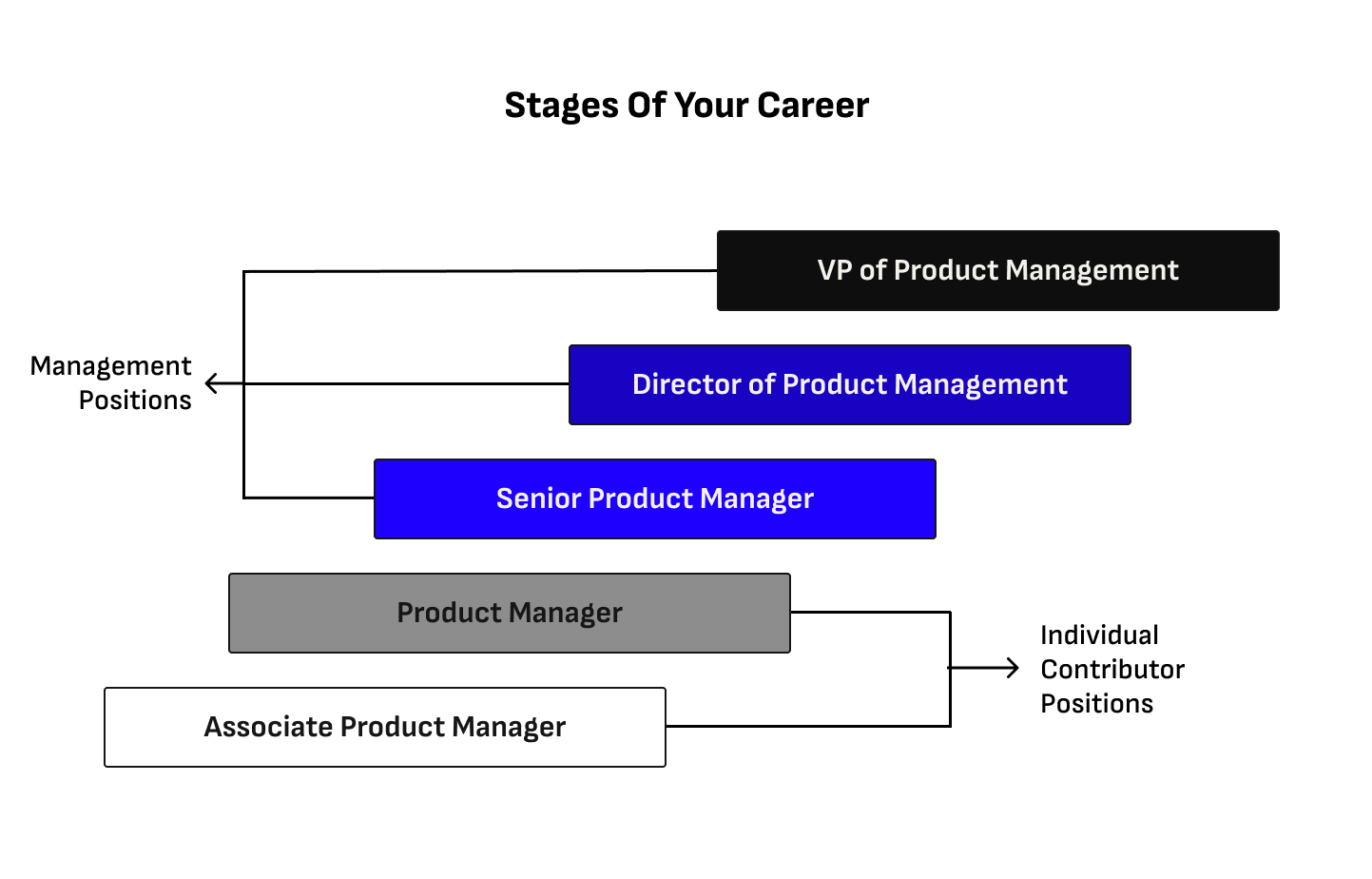
Your career as a PM can be divided into two parts—individual contributor and manager. An individual contributor (IC) focuses on the daily work of ensuring that new products and features are delivered on time and with high quality. A manager manages other PMs with a focus on healthy processes, great team culture, and achieving your company's goals.
Associate PM/product owner
An associate product manager (APM) or product owner role is the first job for many product managers. These are usually people fresh out of college hired directly into product management. They can also be people who have a few years' experience in a related field taking their first product job. Many people get their first job in product in an APM role after making an internal transfer from another job, like customer support, engineering, or design.
The main responsibilities of an APM are to launch individual features by specifying their details to ensure the engineering and design teams build the features correctly and to measure the success of those features. APMs usually are told what to do by a managing PM. As an APM, you usually won't have much choice about your projects but can choose how to complete them.
APMs spend most of their time working with the designers and developers to ensure features are shipped on time and with the right functionality. The rest of their time is spent planning new features, analyzing data from old ones, or trying to learn more about the customers. APMs might also collaborate with more senior PMs and help with the product strategy or be involved in other long-term plans.
To graduate from an APM to the next step, you'll need to show that you can take a feature from "idea" to "launched" with little to no oversight from a manager and that you can oversee multiple features in development simultaneously.
PM/SPM
As a product manager or senior product manager (SPM), you're usually working independently on a small area of a big product or are entirely responsible for a small product.
Your work includes designing features, checking product health, and understanding the users and markets for that product. You'll spend time talking with customers and internal stakeholders about their problems. As your seniority increases, you'll be expected to manage a bigger area of the product, consistently achieve your targets, and do so with even less oversight from your management team.
A PM or SPM often has a bigger say in the product strategy and future work of the team; you'll be delegated fewer features and will be expected to know your users so you can make the right decisions about what to do. Similarly, you'll need to be proactive in seeking out customer and stakeholder feedback—either doing it yourself or in coordination with peers in your design, sales, marketing, and support teams.
Larger companies often divide their PM roles into tiers, like product manager I and product manager II, before you get the senior PM title. To get promoted past that, you need to show that you have strong strategic acumen, can work with no oversight, have great collaboration skills, are an excellent communicator, and that you're ready to manage a team of PMs. One good step forward is demonstrating the ability to manage incoming interns or APMs.
Managing product roles (SPM, GPM, director)
As a manager of other PMs, you oversee the activity of your team and ensure your team is aligned with other teams across the company. Managing PMs usually have titles of senior PM, group PM (GPM), director, or even vice president (VP) depending on the company structure. You'll notice an SPM can be an individual contributor or a manager, depending on the organization.
Managing PMs spend more time analyzing their products, overseeing their teams, working with other PM teams, and constructing the strategy that their teams will follow. If need be, these people can step in and manage individual features.
Executive product roles
An executive PM has a title like VP of product or chief product officer (CPO). They work with the executive team (CEO, other company C-level and VP-level people) to form the company's strategy and to ensure their teams are aligned to it. They also work on the long-term plan of a company (2+ years out). They spend significant time organizing their team—hiring and firing people, structuring their teams, overseeing budgets, and performing other managerial tasks.
Some PMs prefer not to become executives because it means no longer doing much core product management work. Executives do little or no defining features or working with designers and developers. You may also work longer hours at this level. On the other hand, the monetary rewards are significantly higher here, as are the prestige and accolades if you're successful.
Other career paths
There are other avenues besides climbing straight up the product career ladder. It's not unheard of for PMs to move into other roles around the company. For example, a product manager could move in to design, engineering, or operations depending on their skills.
Product management also provides great experience if you want to create your own company and become a founder. Similarly, executive product people often move into CEO roles at companies; it depends on your aspirations and talents.
Activity 🎯
Choose a company that you know a lot about or that you would like to work for one day. Research the company and their product(s) online, and look for information on what their product managers do day-to-day or on the structure and role of the teams they work with.
You may want to choose a company where you know someone that you can ask about this, or even investigate the PM role at your current place of employment. You may also find relevant information on YouTube, on your chosen company's career page, or even in Glassdoor reviews.
Armed with this research, sketch out what you think a product manager's day will look like at this company. Record yourself answering this question: "How would you spend a typical day as a product manager here?" Insert the video into your notebook, and submit a link to it below.
Product management interviews often include questions like this, so it's important for you to fully understand the PM role. You might discuss your answers to this question with your mentor, your peers, or other industry experts.