2.2 Role of Product
Product management is inherently collaborative, and product managers must understand the overall ecosystem of a modern business organization in order to effectively bring products to market.
In this checkpoint, you'll learn how companies are organized, how product fits in, and how those things affect product management work. Product managers are most likely to work at a startup or publicly traded company, so those types of companies will be our focus.
By the end of this checkpoint, you should be able to do the following:
- Describe the structure of a modern company
- Explain how product management fits into modern companies
What is a company?
In general, a company is a group of people who work to conduct commercial activity. You can think of a company as a group of people who build, support, and sell the products that you will be responsible for as a product manager.
Companies are usually run by an executive team that is responsible for setting the company's top-level goals. These executives usually have titles starting in "chief," like chief executive officer (CEO), chief financial officer (CFO), or chief marketing officer (CMO). Sometimes a company doesn't have a C-level person for a function; in that case, there's often a vice president or other representative on the executive team. The executive team sets the strategy for the organization and manages the company's employees and resources.
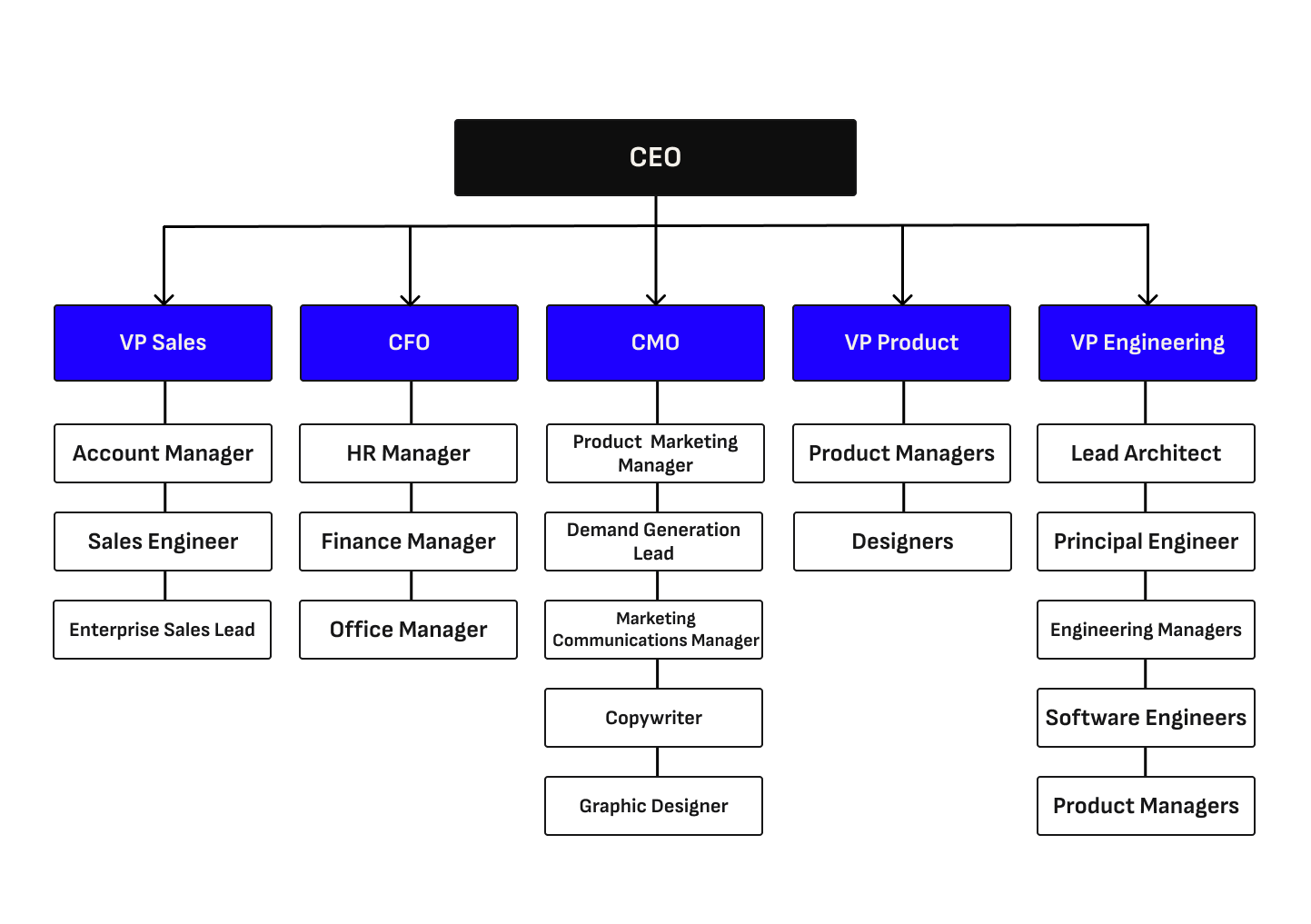
Most companies have a board of directors that is responsible for hiring and firing the CEO and other executive team members. This board meets regularly with the company executives to ensure that the company is achieving its strategic goals, to advise the company on how to better execute, and to help the executives find new opportunities and plan for the future.
Public versus private
One way to divide up companies is to ask whether they are public or private. A public company is one whose shares are traded on a stock market. Many of the best-known tech companies, like Google, Facebook, Microsoft, Apple, and Amazon, are public. At a public company, shareholders elect the board of directors.
In contrast, private companies are owned by an individual or group and are not publicly traded. Startups, individual entrepreneurs, and family-owned companies all fall under the label of private. Private companies may have a board of directors, but not all do. At startups, the biggest investors in the startup typically sit on the board.
The goals of companies
Product managers are always looking for that middle ground between "good for users" and "good for the business." This is why it's important for PMs to understand the goals of businesses. You'll need to make sure your product goals are aligned with your company's goals.
Profit versus non-profit
A for-profit company is trying to make money from the goods or services it sells. For example, if you're producing cell phones like Samsung, your company profits when the phone sells for more than the total cost of producing it. The term margin refers to this ratio between the cost to produce and the cost of sale. Specifically, the following formula is used to compute margins:
margin = 100 * (revenue - costs) / revenue
In order to increase profits, there are several high-level strategies:
- Increase revenue by increasing a product's sale price
- Decrease costs by finding more efficient ways to create the product
- Increase sales volume while maintaining stable margins
By contrast, non-profit companies are not concerned with making money on every transaction. Instead, they focus on other benefits, like social good or helping people, like what we are doing with PMcademy 😍
Goals of startups versus public companies
Public companies strive to achieve predictable growth and profitability so that their shareholders can get a return on their investment. By contrast, startups strive to achieve rapid growth and manage costs, even if they're not (yet) profitable.
When you work for a startup, your main goal is to grow and capture as much of a market as possible, even if it's not profitable. Investors in startups provide the capital for the startup to grow with an expectation that they'll get a return on their investment when the company exits.
An exit is an event where the investors can reap the rewards of their investments in a startup. The most common exits are:
- IPO (initial public offering): A company transitions from being a private to a public company. Investors and employees make money by selling their shares on the stock market.
- Being acquired: One company purchases another. In this scenario, investors make money by getting cash for their shares in the startup.
- Merger: The company combines with another (often a competitor or complementary product).
- Acquiring other companies: The company begins to acquire other companies.
Your startup doesn't have to be profitable to achieve an exit. In fact, many tech companies continue to lose money even after they've had an IPO. Uber lost over $5 billion in one quarter in 2019 after their IPO. What's important is to look past profit/loss numbers and see if the other indicators of growth are moving in the right direction.
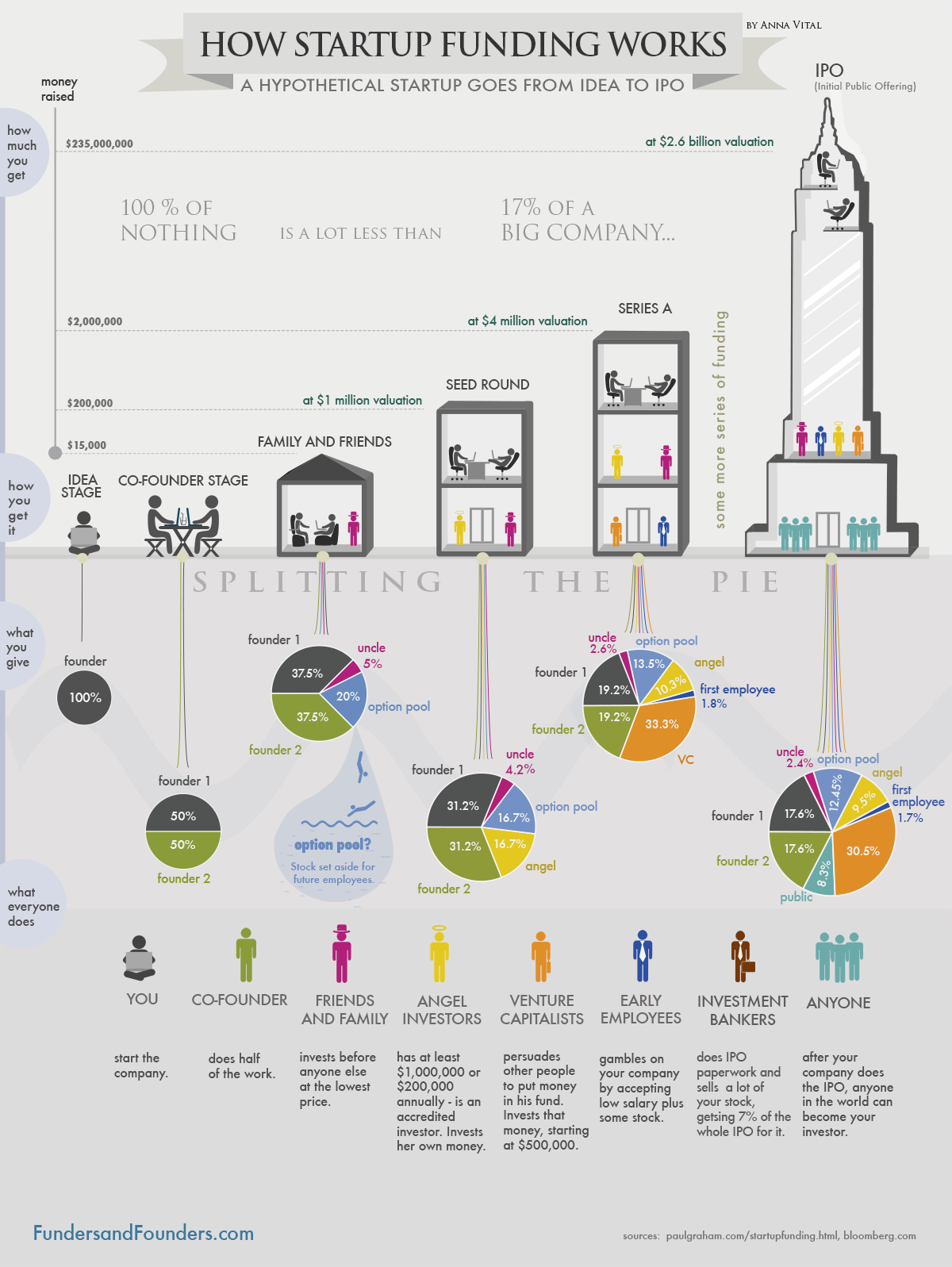
The below chart gives a detailed explanation on how startups grow and how they are funded. Note, that not all startups require funding, some are bootstrapped too
How companies are organized
A company is made up of individuals with many skills and specialties, and the executive team focuses on orchestrating individual efforts to maximize business success. As a product manager, you'll work with people across a wide range of functions. You need to know what their responsibilities are so you can understand how to help them and how they can help you.
You'll take a look into this in more detail below. First, you'll learn about the major functions within a company. Then, you'll explore common ways that companies organize those functions.
Product
Obviously, product managers work on the product team. The product team can also include related roles like data analysts, designers, or even project managers. As product teams grow, they usually divide their responsibilities based on functions of the product—for instance, Gmail's inbox view versus its compose window, specific groups of users (small versus large businesses), or skills (mobile application developers versus web application developers).
Design
If a company is large enough to have a design team, that's usually where your user experience designers will live. If your company is smaller, designers may belong to the product team. Besides providing the look and feel of the products, design teams can also provide user research to improve a product manager's understanding of the users.
Engineering
The engineering team is responsible for building software and hardware for a company's products. This also includes managing the infrastructure (servers) that run the company's software. You'll learn much more about engineering responsibilities later in the course.
Sales
Sales teams focus on getting the product into the hands of customers, especially in companies that sell their products to other businesses. They're on the front lines with users every day, so they're an invaluable source of feedback about what is and isn't working in a product. Sales teams are also knowledgeable about competitive or substitute products.
Marketing
Marketing teams get the word out about your products. For product managers, marketing teams can help acquire new users and better convert customer leads into paying customers. They can also help improve the effectiveness of product communications and presentations.
Support
When a customer encounters a problem with a product and needs help, they turn to the support team. For product managers, support teams can provide a wealth of information on common customer problems. They will be able to identify customers for the product manager to talk to as part of ongoing product research.
Operations
Operations teams do all the other "dirty work" of a company, including human resources (HR, sometimes also called "people team"), finance, legal, and other functions that are used by all the teams within the company.
Ways of organizing companies
Companies organize these teams in various ways. Understanding how a company is organized is an important step in figuring out how the product team functions within it.
Functional organization
Many companies organize their employees based on their function: all the product people together, marketing together, sales, and so on. This approach optimizes for peer collaboration across the same function. Organizing by function makes it easy to exchange specialized knowledge within the team. However, this approach can make cross-functional collaboration (that is, doing work with a team that spans job functions) more difficult. This organizational approach tends to work well in small companies and early-stage startups because collaboration is inherently easier when there are fewer employees overall.
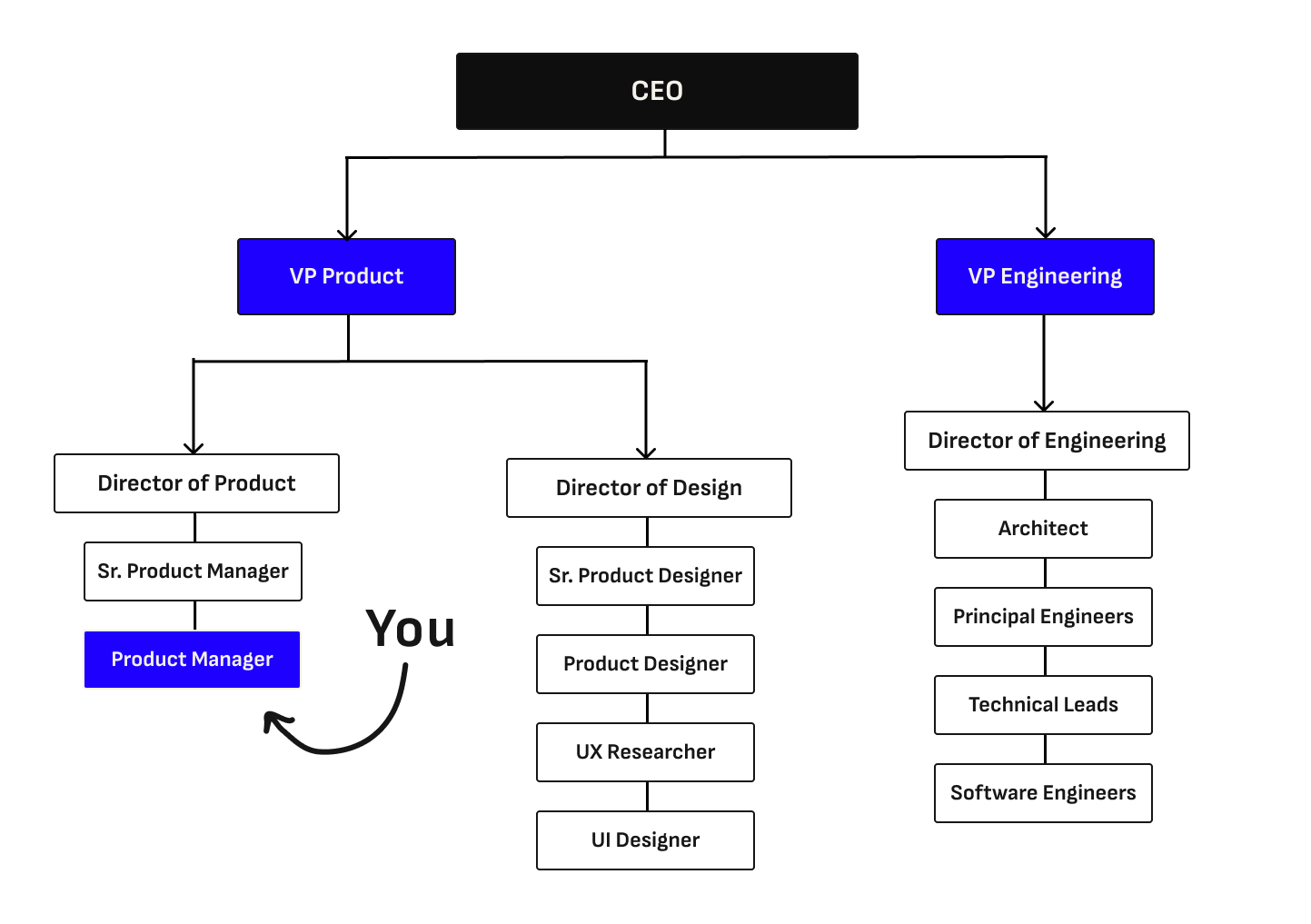
If you're a PM in a functional organization, you'll have excellent collaboration and communication from other product managers and designers. On the other hand, you'll have to be proactive in getting the help you need from marketing and sales to ensure your product's success.
Product organization
Another way to organize a company is to divide teams by product and have people from all functions in each product team. In a way, each team functions like a micro-company within a larger business. For example, Apple has a group responsible for creating and selling their phones and a separate team in charge of their applications. Those groups look similar in terms of the functions of the people in them.
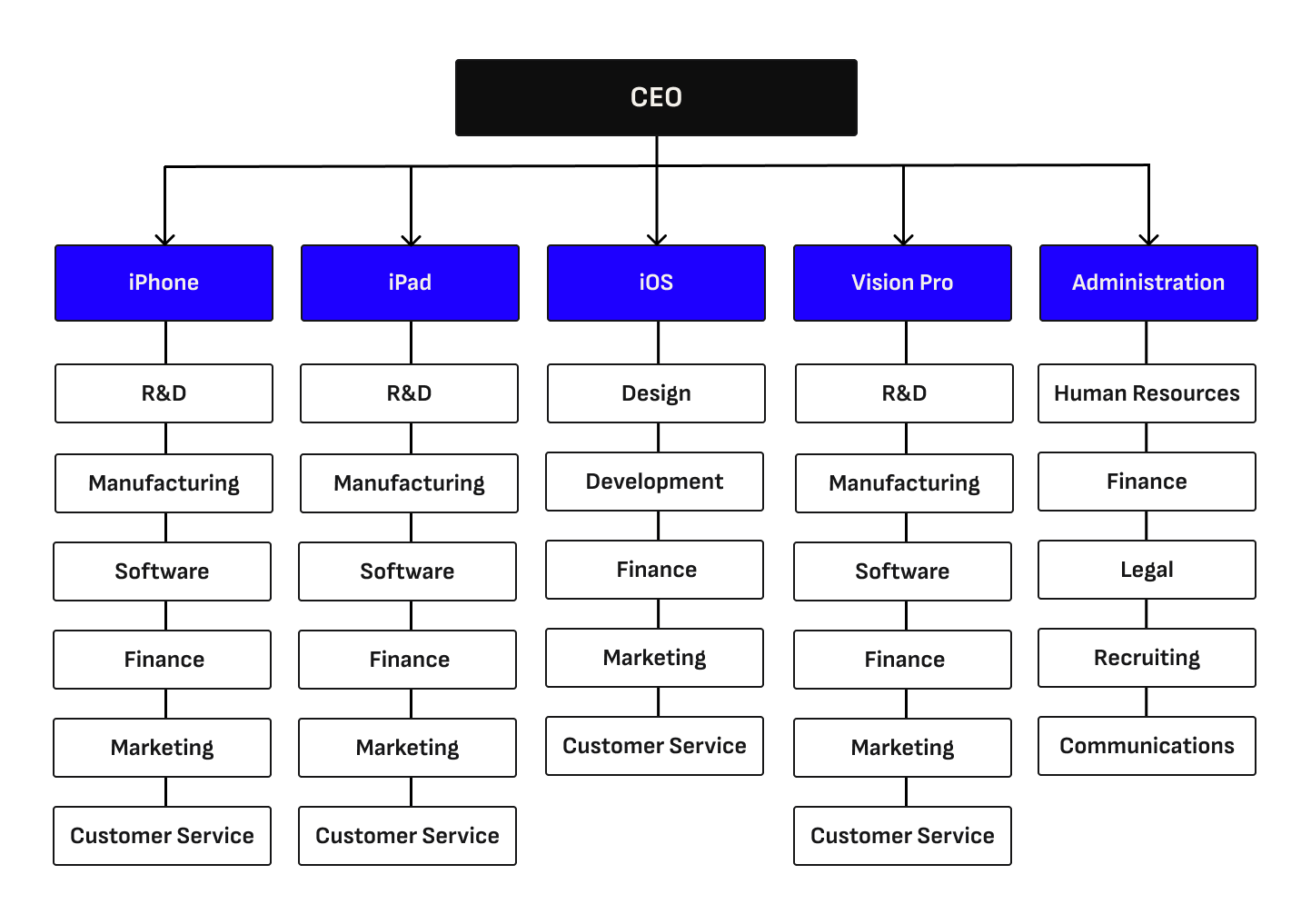
As a PM in a product organization, you'll be working closely with marketing, sales, and all the other functions needed to run your product successfully. While that closeness is beneficial, you will have to work harder to collaborate with teams focusing on other products and learn from other PMs.
Matrix organization
A matrix organization is one that doesn't have fixed teams. Instead, teams are created based on the demands of any individual project. Representatives of each function (project manager, sales, engineering, etc.) work together as a team focused on a specific project. (This is represented by rows in the diagram below.) Matrix organizations enjoy lots of flexibility and can assign the required number of people based on project needs to maximize their use of resources. However, it can be confusing for employees because it's not always clear who's responsible for making decisions or who you can contact for help on specific issues.
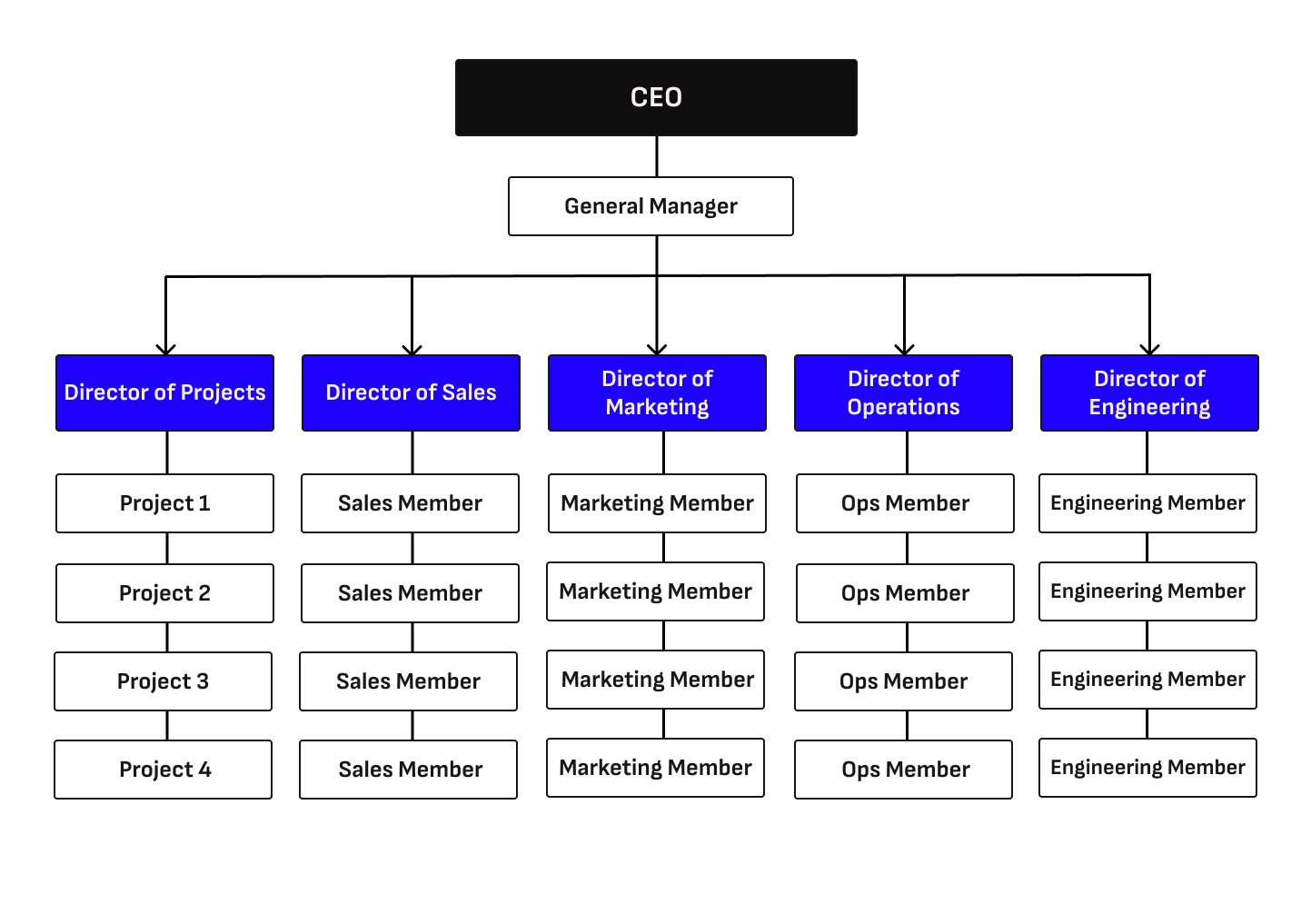
If you're a PM in a matrix organization, you'll often be working with new people on every project. You'll need to focus on creating healthy team dynamics and help the people working with you to find their bearing. The downside of working in Matrix organizations is that it can be hard to navigate, and you constantly need to build relationships with new team members.
The video below by Alexander Lyon provides a summary of these ways of organizing a company and gives specific examples of organizations that different companies have used.
Your product team
Regardless of how their organization is structured, product teams have similar characteristics.
Who's on the team
Your product team will include you and the other product managers responsible for running your products. The team is usually led by a VP of product, or CPO, but it's not unusual to report to a chief technical officer (CTO), a startup co-founder, or a head of product. At a large company, you may report to a director of product, who in turn reports to a VP or CPO; this helps your manager do a more effective job of overseeing your work.
Depending on the organization, product teams can also include designers or analysts. This is common at startups, where designers often report to product management until there are enough designers to form a dedicated design team.
Your top peers
Your most important peers are the product, engineering, and design teams. These are the teams you'll be working with on a day-to-day basis, and the teams that will depend on you the most. Much of this curriculum will discuss how to effectively work with these peers.
The next most important set of peers are the ones who have direct contact with the users. Your sales, support, and sometimes marketing teams are most likely to speak with—and get feedback from—your users. They can help you make better decisions, and they love to hear about what the product team will be working on next.
Product managers versus similar managers
A Product manager is often confused with other kinds of managers, such as a project manager or a program manager. Your friends and family will probably mess this up many times, to your great frustration. Here is the difference between each of these titles, and the kind of collaborative relationship you as a product manager may have with them.
Nontechnical product manager
Many industries have product managers, but not all are the kind of product managers this program is focused on training. For example, fashion brands often have product managers who handle the manufacturing, distribution, and sales of clothing and accessories. Similarly, banks and insurance companies have product managers for product lines of loans, credit cards, and insurance. Those companies may also have tech product managers, like PMs, for running their e-commerce websites or mobile applications. Read job descriptions carefully to ensure you're looking at the right kind of PM role.

Project manager
A project manager is responsible for making sure project deliverables are completed on time. They ensure features are built without delays or blockages and that teams have everything they need to be successful. They also often manage team processes, run meetings, and handle communications. Unlike product managers, they do not work on strategy, features, or other core product work. Many companies do not have dedicated project managers; instead, the product manager also acts as a team's project manager. For this reason, you'll learn project management skills later in this course.
Program manager
Program managers generally are responsible for cross-team collaboration and long-term strategic initiatives. In some companies, a program manager is like a very senior product manager with a focus on strategy and planning. In other companies, they are very senior project managers who work on process and communication. If you end up working with a program manager, meet with them to understand how they operate and what this versatile title means in your company.
Product marketing manager
A product marketing manager (PMM) is a peer to a product manager with a focus on marketing tasks, such as promotion and pricing. To contrast the roles, a PM works most closely with tech and design teams, while a PMM works most closely with marketing and sales teams. PMMs can help you get customer feedback and achieve product growth. If you have lots of experience in marketing, it may be easier for you to get your first product management role as a PMM.
Liam Bolling does a great deep dive into the difference between Product, Program and Project Management
Test Your Understanding ✍️
In your notebook, write up short answers to the following questions:
Who do product managers work with most often? Describe what each team in a company may need from a product manager, and what they can provide to help the PM run their product. Do you have any experience working with these teams? What do you know about them, and what else do you want to know to better collaborate with them as a PM?
Analyze at least three organizations you know well. These could be your past employers or other businesses you are familiar with. What kind of organizational structure do they use—matrix, functional, or product? How did/will that impact the work experience?